
Listing on SSE is very costly – Is it? Myths and Reality


For many non-profit organizations exploring the Social Stock Exchange (SSE), one concern consistently surfaces before any other:
“Is listing on the SSE prohibitively expensive?”
The perception that listing on the SSE involves substantial expenditure has become one of the barriers to adoption. Yet, a closer examination of regulatory practice, approved Fund Raising Documents (FRDs), and actual market transactions suggests a very different reality.
The evidence indicates that most costs associated with an SSE issue are not only reasonable and comparable to traditional fundraising expenditures but are also ordinarily included within the overall project cost and funded from the issue proceeds themselves. In practical terms, the cost of accessing institutional philanthropy through the SSE may be significantly lower than what many organizations currently spent on fragmented fundraising campaigns, crowd funding sites, events and consultant engagements.
The question, therefore, is not whether NGOs can afford to access the SSE, but whether they can afford to ignore a platform that creates transparency, credibility, and access to larger pools of social capital.
The Regulatory Position: What Constitutes Permissible Issue Expenses?
Neither the Securities and Exchange Board of India, NSE , nor BSE has issued any circular defining permissible listing or issue-related expenses.
However, a practical framework has emerged through:
- Approved and draft Fund Raising Documents (FRDs)
- SSE disclosure templates and checklists
- Issue expense statements accepted by exchanges
- Practice followed by listed non-profit organizations.
Across approved filings, the following categories have consistently been disclosed and accepted as legitimate issue-related expenditures:
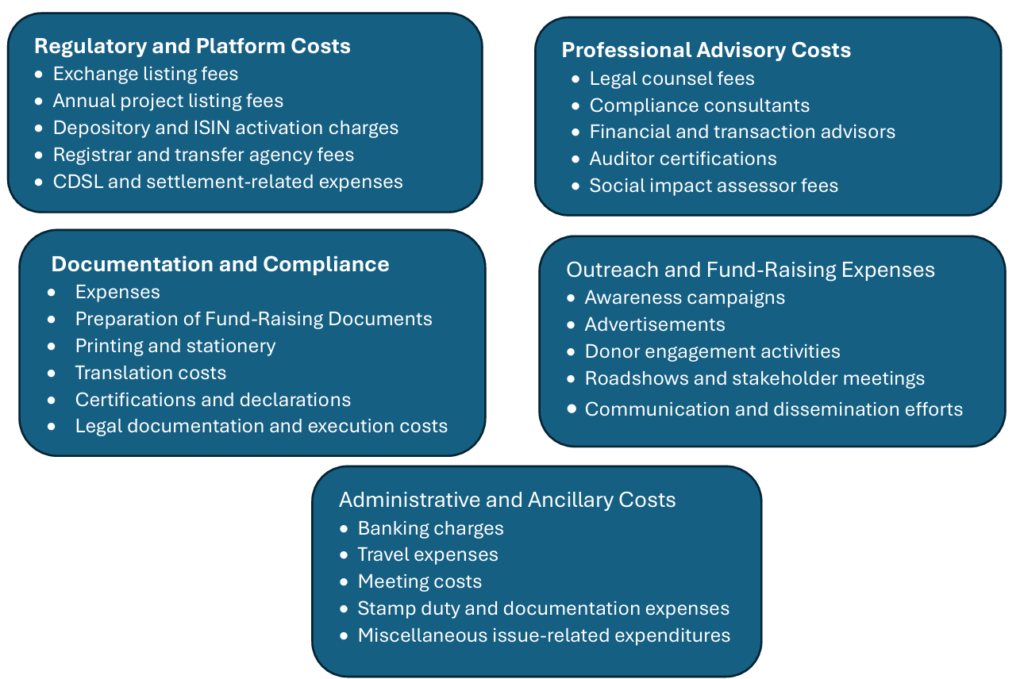
Across the Fund Raising documents on the SSE, all these expenses have been transparently disclosed as Issue related expenses and have been permitted as Project costs.
How fundraising costs on SSE Compare with Traditional Fundraising?
The belief that SSE fundraising is expensive often arises because organizations view listing expenses in isolation rather than comparing them with conventional fundraising methods.
A traditional fundraising campaign typically involves:
- Fees to crowd funding platforms, fundraising agencies
- Proposal development consultant fees and
- Audit and compliance costs
These costs are often recurring and distributed across multiple funding efforts.
By contrast, most SSE-related expenditures—particularly legal, documentation, structuring, and listing expenses—are substantially one-time in nature and create long-term institutional infrastructure for future fundraising. What one would raise every year otherwise, is raised one time for the entire project on SSE.
Excluding independent impact assessments, many organizations incur these costs only during their initial issue process.
Viewed over a multi-year project horizon, the cost per rupee mobilized becomes remarkably efficient on SSE.
The SSE should therefore be understood not as an additional compliance burden but as an investment in institutional credibility, governance, transparency, and access to larger philanthropic capital pools.
Listing Costs Are Part of the Project Cost and not an Out-of-pocket expense
Perhaps the most significant misunderstanding in the sector is the assumption that SSE listing costs must be borne separately by the organization.
In practice, approved Fund Raising Documents indicate that issue-related expenses are included within the total issue size itself.
A typical disclosure language adopted in several filings is:
“The issue size includes provision for SSE listing and issue-related expenses, which shall be funded through the proceeds raised under the Issue.”
Issue expenses as a percentage of the overall funds mobilized are comparable with cost of fundraising from crowd funding and fund raise through agencies. For larger issues, this percentage becomes even more modest due to economies of scale.
Independent Impact Assessment Costs
This is the only additional cost item directly resulting from listing. Impact assessment is not merely a cost incurred due to listing – it is a project delivery and accountability mechanism and very much a Project cost element.
As such there is no barrier to include this cost for the entire project duration within the project budget itself.
This can include:
- Baseline studies
- Midline assessments
- End-line evaluations
- Outcome verification
- Social return analysis
- Third-party validations
- Beneficiary feedback mechanisms.
Specific inclusion of these costs strengthens transparency, improves donor confidence, and aligns with the fundamental philosophy underlying the Social Stock Exchange: measurable, verifiable, and accountable social impact.
In fact, independent impact assessment should be viewed not as a cost of accessing capital, but as an investment in demonstrating outcomes and building long-term institutional trust.
The Social Stock Exchange is more than a fundraising platform:
It creates:
- Institutional credibility
- Standardized disclosures
- Greater transparency
- Improved visibility
- Access to sophisticated donors and philanthropies
- Repeat fundraising mechanism
When examined through this lens, discussion shifts from cost to value.
Most traditional fundraising methods involve hidden and recurring expenditures that are rarely measured comprehensively. SSE-related expenses, on the other hand, are transparent, disclosed, accountable, and financed from issue proceeds themselves.
For NGOs these costs should be viewed as foundational investments rather than barriers.
The cost of going to the Social Stock Exchange is not the price of compliance—it is the cost of building trust at scale
Recent Blogs